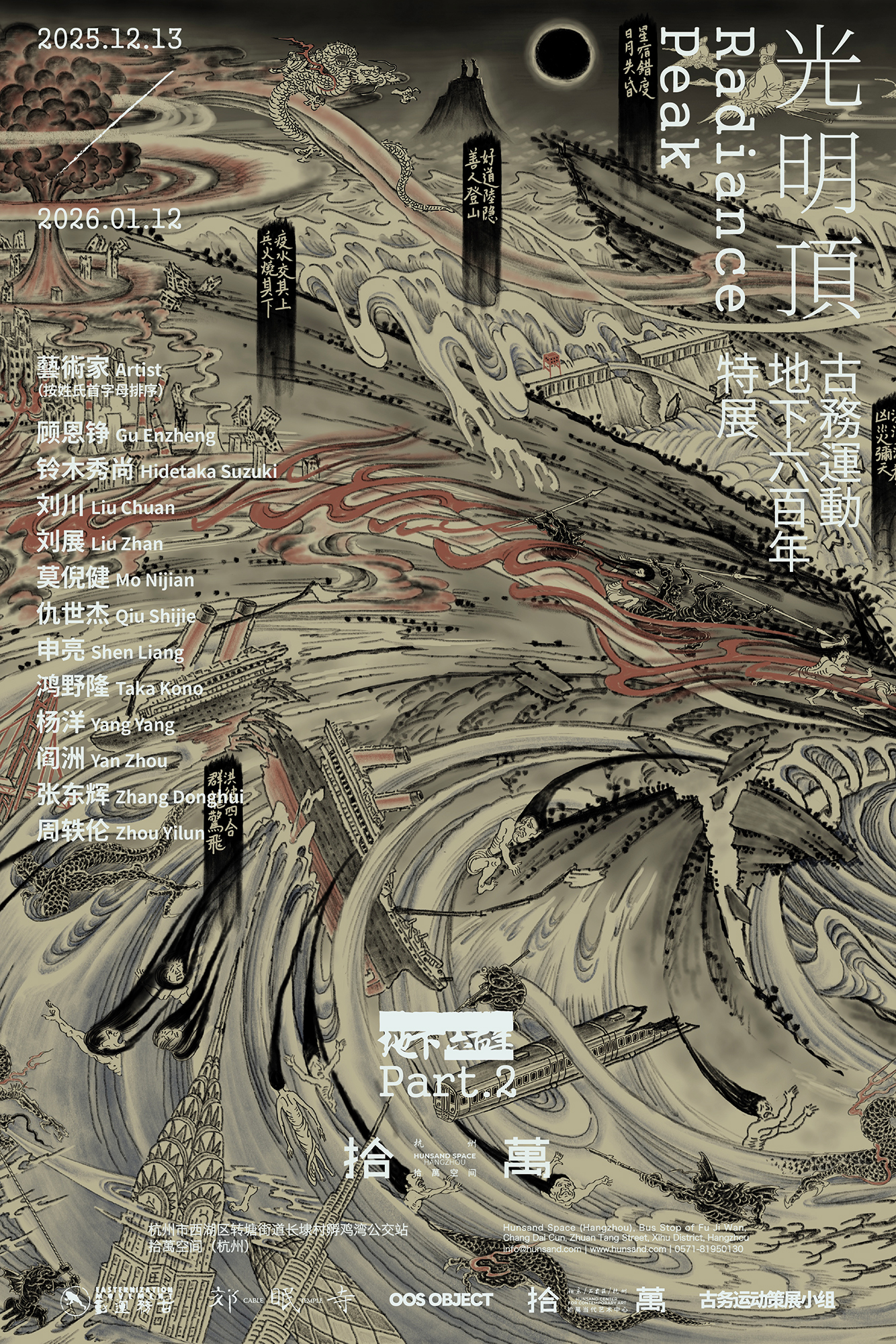
I’m currently participating in a group exhibition at Hunsand Space in Hangzhou.
It seems to be an exhibition with a very interesting theme, so if you’re in the area, be sure to check it out.
Easternization Movement: Radiance Peak
Artist: Gu Enzheng, Hidetaka Suzuki, Liu chuan, Liuzhan, Mo Nijian, Qiu shijie, Shen Liang, Takakono, Yang Yang, Yan Zhou, Zhang Donghui, zhou Yilun
Duration: December 13, 2025 – January 12, 2026
Opening: 4:00 PM, Saturday, December 13, 2025
Address: Bus Stop of Fu Ji Wan, Chang Dai Cun, Zhuan Tang, Xihu District, Hangzhou
Radiance Peak, situated in the Kunlun Mountains, is portrayed as the sacred headquarters of the Ming Cult in Jin Yong’s fiction. This Ming Cult is a literary creation by Jin Yong, synthesizing elements from Manichaeism and Zoroastrianism.
Zoroastrianism and Manichaeism, together with Nestorian Christianity, are historically known as the “Three Foreign Religions” of medieval China. They flourished during the Sui and Tang dynasties before being suppressed and driven underground. In 1357 (late Yuan Dynasty), representatives of Han Chinese Chan Buddhism (from Shaolin) and Daoism (from Wudang) gathered at the Peak of Radiance. Conflict erupted with the remaining members of the Ming Cult, which eventually gave way to reconciliation. Deities from diverse origins and martial artists of extraordinary skills united under the banner of nationalism (to resist the Yuan), forming a common front. Their chants evolved from “Burn my wounded body, blazing flames” to “Expel the Tatar invaders, restore the Central Plains (Zhonghua).”
In reality, from the late Han to the end of the Qing, and from the Republican era to the War of Resistance, such phenomena have recurred throughout China’s history. Radiance Peak is but one small fragment. Beyond our sight, the intertwined rivers of mentalities, society, and politics have surged forward, flowing incessantly.
This exhibition, Radiance Peak, brings together recent works by friends from the Easternization Movement. Among them are wounded gods of war, a veiled Jesus, a disrobed Bodhisattva, and decapitated spirits. In the visible narrative of history, they reside beyond, receiving worship and incense. Yet in an inverted mirror, whenever mountains crumble and seas boil, they fall like rain, shattering with audible cracks, manifesting within generations of turbulent flesh or being performed by generations of refined intellects. They struggle amidst blood and wild flames.
–
我目前正在杭州浑沙空间参加一个群展。
这个展览的主题似乎很有意思,如果你在附近的话,一定要去看看。
艺术家:顾恩铮、铃木秀尚、刘川、刘展、莫倪健、仇世杰、申亮、鸿野隆、杨洋、阎洲
张东辉、周轶伦
展览:光明顶
展览时间:2025年12月13日 -2026年1月12日
开幕时间:2025年12月13日 周六 16:00
地址:杭州市西湖区转塘街道长埭村孵鸡湾公交站
光明顶,位于昆仑山,是所谓明教总坛所在。而这个明教,是金庸融合了摩尼教和拜火教创制而成。
拜火教和摩尼教,与基督教聂斯托里派,并称中国中古三夷教,隋唐兴盛,之后转为地下。1357年(元末),汉地禅宗(少林)、道教(武当)等代表同聚光明顶,与明教留守人员产生争斗,最终,他们和解:这些来自五湖四海的神祇,各怀异能的江湖人士,在民族主义大旗(抗元)之下,成立了统一战线。他们的歌谣,从“焚我残躯,熊熊烈火”,转而成为“驱除鞑虏,恢复中华”。
实际上,我国从汉末到清末,从民国到抗战,这样的事情一直在发生。光明顶只是一个小小切片,在我们看不到的地方,心灵史、社会史、政治史交织成河,久久奔腾。
此次「光明顶」由古务运动朋友们近期的作品组成,其中,有受伤的战神,蒙面的耶稣,宽衣的菩萨,断头的精怪……在可见的历史中,祂们身在彼岸享受香火,而在倒转的镜像中,每当山崩海沸,祂们堕落如雨,崩裂有声,显灵于一代代滚滚肉身,或被一代代精致的头脑所扮演。祂们挣扎在鲜血与野火之中。
–
杭州のHunsand Spaceでグループ展に参加しています。
とても興味深いテーマの展覧会なので、もしお近くにおられる際にはぜひご覧ください。